> ## Documentation Index
> Fetch the complete documentation index at: https://docs.greenflash.ai/llms.txt
> Use this file to discover all available pages before exploring further.
# Product Quality Index (PQI)
> Define what quality means for your product and make every Greenflash analysis act on it.
*Most tools observe. Greenflash decides.*
**PQI is where you define what “good” looks like.**
Once you do, every score, chart, drilldown, and suggestion adheres to that definition.
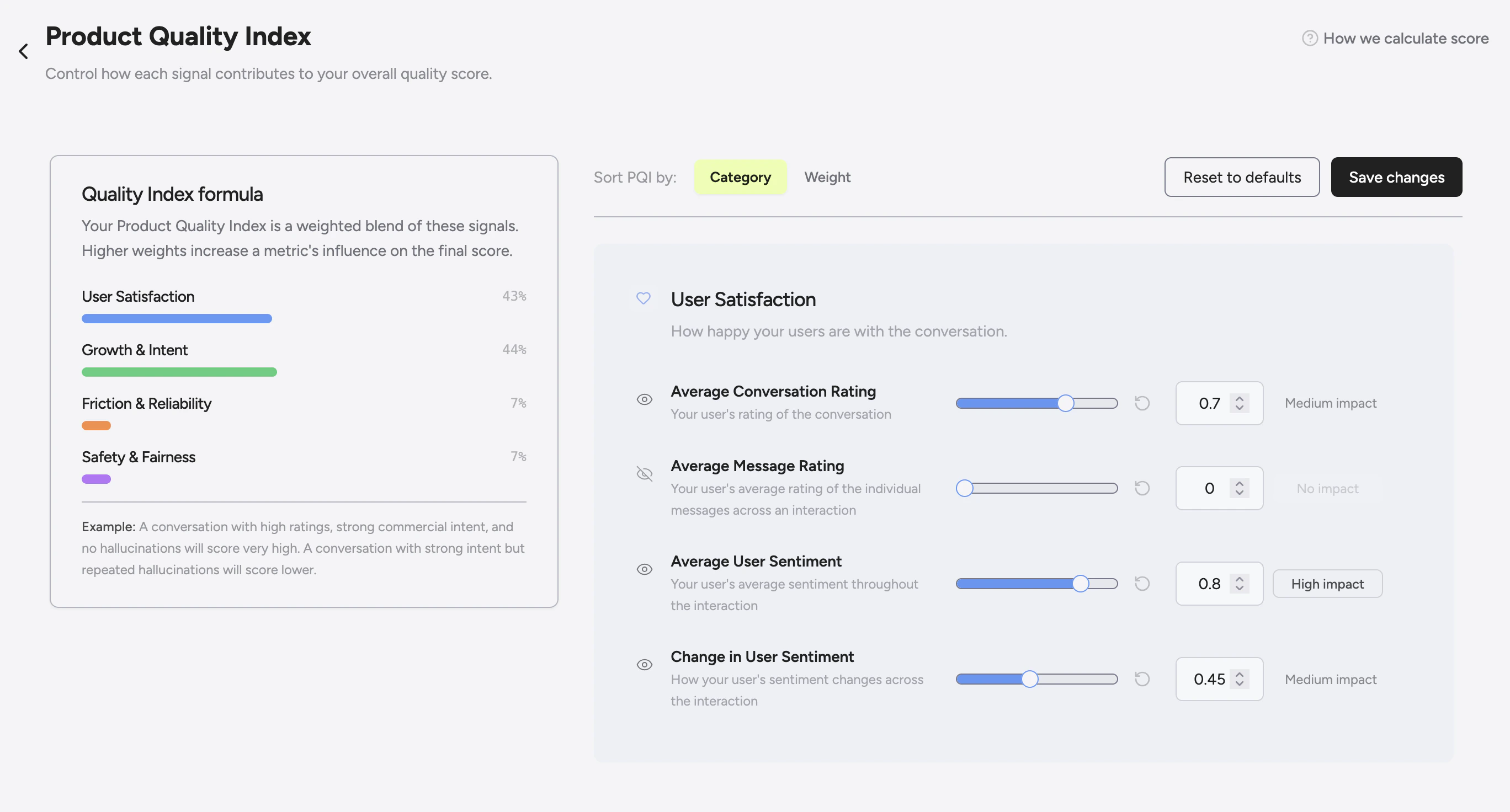 **PQI is your quality philosophy, enforced in your product.**
Change it once. Greenflash applies it everywhere.
## What PQI actually does
PQI turns quality from a subjective debate into a consistent system.
You decide what matters. Greenflash uses that definition to:
* **Prioritize what deserves attention first**
Interactions and prompts are ranked by impact on your quality bar.
* **Track product health with a single, meaningful score**
One trendline that reflects your goals, not a generic average.
* **Generate better suggestions**
Prompt and guardrail recommendations optimize for your priorities, not best-practice folklore.
If PQI feels opinionated, that’s intentional. Neutral analytics are easy. Useful ones are not.
## What you can weight
PQI is composed of signals grouped into four categories. Each weight is a value judgment.
| Category | What it captures | Example signals |
| :------------------------- | :---------------------------------------- | :----------------------------------------- |
| **User Satisfaction** | How users *feel* about the experience | Ratings, sentiment, tone |
| **Growth & Intent** | Whether conversations drive outcomes | Commercial intent, upgrades, conversions |
| **Friction & Reliability** | Where users struggle or the system breaks | Confusion, frustration, failed resolutions |
| **Safety & Fairness** | The non-negotiables | Hallucinations, jailbreaks, toxicity, bias |
Your weights define what “good” means.
Greenflash applies that definition everywhere.
## How to configure PQI weights
Start simple. PQI becomes powerful when it reflects a real tradeoff your team would actually defend.
Practical approach:
* **Pick your primary outcome**
Revenue? Resolution? Trust? Choose one and weight toward it.
* **Keep a “non-negotiables” floor**
Even if you’re revenue-first, keep safety signals meaningful so the system can protect you.
* **Weight what you can act on**
If a signal can’t be influenced by product or prompt changes, de-emphasize it.
* **Close the loop with business outcomes**
If you track upgrades, churn, or conversions, connect them via **[Business Events](/features/events)** so PQI reflects reality—not vibes.
## Why this matters
**PQI makes Greenflash useful under pressure.**
When quality drops, you don’t want more dashboards.
You want the right interactions surfaced and the right fixes suggested.
PQI ensures that happens automatically.
You can technically zero out inconvenient signals. That is not optimization.
If you want Greenflash to protect you, keep safety weights meaningful.
## What changes when you change PQI
Changing PQI weights changes what Greenflash considers “high impact” and what it surfaces first.
What you’ll notice:
* **Dashboards and drilldowns reorder**
Conversations, prompts, and issues are re-ranked by impact on your current definition of quality.
* **Insights emphasize different problems**
The “top issues” shift toward whatever you weighted up.
* **Suggestions target different fixes**
Recommendations optimize for your priorities (and the tradeoffs you encoded).
That’s the point:
**one definition of quality, consistently applied across the product.**
If you’re doing a before/after review, note when you changed PQI weights so you can interpret shifts in trendlines and rankings correctly.
## Opinionated weight profiles
These are not best practices.
They are **stances**.
Choose the one that matches how your product wins.
***
### Revenue-first
*Growth without delusion.*
Optimize for conversion and retention without sacrificing trust.
* **Weight up** intent and positive outcomes
* **Keep meaningful** hallucinations and jailbreaks
**What changes**
* Top conversations align with revenue movement
* Suggestions focus on intent capture and drop-off reduction
***
### Support-grade reliability
*Fewer escalations. Less churn.*
Optimize for first-try resolution.
* **Weight up** struggle, frustration, and resolution
* **Include** negative outcomes like cancellations or escalations, if tracked
**What changes**
* Drilldowns surface stuck conversations first
* Suggestions emphasize clarity and next-step correctness
***
### Safety-first
*For regulated or high-risk domains.*
If safety is the product, PQI should treat it that way.
* **Weight up** hallucination, jailbreak, toxicity, and bias
* **De-emphasize** growth until safety stabilizes
**What changes**
* Top issues are trust failures, not cosmetic UX problems
* Suggestions prioritize guardrails and refusal correctness
## A simple example, with real consequences
Two conversations are evaluated using the same underlying signals—but PQI weights change what gets prioritized.
**User is happy.**
Satisfaction is high.
The assistant, however, hallucinates a policy detail.
Satisfaction is slightly lower.
**The user completes an upgrade.**
No safety signals are triggered.
***
### How PQI changes the outcome
* With **satisfaction-heavy weights**, **Conversation A** is surfaced first.
* With **growth/intent-heavy weights**, **Conversation B** is surfaced first.
Nothing about the conversations changed.
Only your definition of quality did.
***
### Why this matters
That single preference determines:
* which conversations are reviewed next
* what your insights page emphasizes
* what Greenflash suggests you change
**PQI doesn’t explain outcomes. It decides which ones matter.**
## Where to go next
Make changes that align with your quality definition, not generic advice.
Close the loop by weighting real outcomes.
**PQI is your quality philosophy, enforced in your product.**
Change it once. Greenflash applies it everywhere.
## What PQI actually does
PQI turns quality from a subjective debate into a consistent system.
You decide what matters. Greenflash uses that definition to:
* **Prioritize what deserves attention first**
Interactions and prompts are ranked by impact on your quality bar.
* **Track product health with a single, meaningful score**
One trendline that reflects your goals, not a generic average.
* **Generate better suggestions**
Prompt and guardrail recommendations optimize for your priorities, not best-practice folklore.
If PQI feels opinionated, that’s intentional. Neutral analytics are easy. Useful ones are not.
## What you can weight
PQI is composed of signals grouped into four categories. Each weight is a value judgment.
| Category | What it captures | Example signals |
| :------------------------- | :---------------------------------------- | :----------------------------------------- |
| **User Satisfaction** | How users *feel* about the experience | Ratings, sentiment, tone |
| **Growth & Intent** | Whether conversations drive outcomes | Commercial intent, upgrades, conversions |
| **Friction & Reliability** | Where users struggle or the system breaks | Confusion, frustration, failed resolutions |
| **Safety & Fairness** | The non-negotiables | Hallucinations, jailbreaks, toxicity, bias |
Your weights define what “good” means.
Greenflash applies that definition everywhere.
## How to configure PQI weights
Start simple. PQI becomes powerful when it reflects a real tradeoff your team would actually defend.
Practical approach:
* **Pick your primary outcome**
Revenue? Resolution? Trust? Choose one and weight toward it.
* **Keep a “non-negotiables” floor**
Even if you’re revenue-first, keep safety signals meaningful so the system can protect you.
* **Weight what you can act on**
If a signal can’t be influenced by product or prompt changes, de-emphasize it.
* **Close the loop with business outcomes**
If you track upgrades, churn, or conversions, connect them via **[Business Events](/features/events)** so PQI reflects reality—not vibes.
## Why this matters
**PQI makes Greenflash useful under pressure.**
When quality drops, you don’t want more dashboards.
You want the right interactions surfaced and the right fixes suggested.
PQI ensures that happens automatically.
You can technically zero out inconvenient signals. That is not optimization.
If you want Greenflash to protect you, keep safety weights meaningful.
## What changes when you change PQI
Changing PQI weights changes what Greenflash considers “high impact” and what it surfaces first.
What you’ll notice:
* **Dashboards and drilldowns reorder**
Conversations, prompts, and issues are re-ranked by impact on your current definition of quality.
* **Insights emphasize different problems**
The “top issues” shift toward whatever you weighted up.
* **Suggestions target different fixes**
Recommendations optimize for your priorities (and the tradeoffs you encoded).
That’s the point:
**one definition of quality, consistently applied across the product.**
If you’re doing a before/after review, note when you changed PQI weights so you can interpret shifts in trendlines and rankings correctly.
## Opinionated weight profiles
These are not best practices.
They are **stances**.
Choose the one that matches how your product wins.
***
### Revenue-first
*Growth without delusion.*
Optimize for conversion and retention without sacrificing trust.
* **Weight up** intent and positive outcomes
* **Keep meaningful** hallucinations and jailbreaks
**What changes**
* Top conversations align with revenue movement
* Suggestions focus on intent capture and drop-off reduction
***
### Support-grade reliability
*Fewer escalations. Less churn.*
Optimize for first-try resolution.
* **Weight up** struggle, frustration, and resolution
* **Include** negative outcomes like cancellations or escalations, if tracked
**What changes**
* Drilldowns surface stuck conversations first
* Suggestions emphasize clarity and next-step correctness
***
### Safety-first
*For regulated or high-risk domains.*
If safety is the product, PQI should treat it that way.
* **Weight up** hallucination, jailbreak, toxicity, and bias
* **De-emphasize** growth until safety stabilizes
**What changes**
* Top issues are trust failures, not cosmetic UX problems
* Suggestions prioritize guardrails and refusal correctness
## A simple example, with real consequences
Two conversations are evaluated using the same underlying signals—but PQI weights change what gets prioritized.
**User is happy.**
Satisfaction is high.
The assistant, however, hallucinates a policy detail.
Satisfaction is slightly lower.
**The user completes an upgrade.**
No safety signals are triggered.
***
### How PQI changes the outcome
* With **satisfaction-heavy weights**, **Conversation A** is surfaced first.
* With **growth/intent-heavy weights**, **Conversation B** is surfaced first.
Nothing about the conversations changed.
Only your definition of quality did.
***
### Why this matters
That single preference determines:
* which conversations are reviewed next
* what your insights page emphasizes
* what Greenflash suggests you change
**PQI doesn’t explain outcomes. It decides which ones matter.**
## Where to go next
Make changes that align with your quality definition, not generic advice.
Close the loop by weighting real outcomes.